Why Merit Isn’t Enough

Epistemic status: informed speculation

I.

I played the trombone for 11 years. If you ask trombone players who the best trombone player in the world is, everyone says Joe Alessi. He’s the only professional trombone player most non-professional trombone players can name (aside from perhaps Trombone Shorty and Christopher Bill). [1]

Why the consensus? Is he really that much better than all the other pros?

II.

I asked a friend and fellow trombone player about this once, and he said Joe’s title as “best in the world” comes from his talent at self-promotion. He’s not the only world-class trombone player, but he is the only one with both that level of talent and the ability to market himself effectively. [2]

Think of it this way. Imagine you’re trying to decide who the best trombone player in the world is, and you’re faced with 10 people who are all incredible.
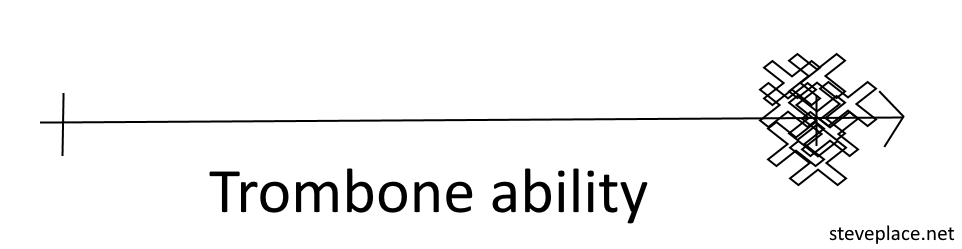
Each X represents a trombone player

It would be hard to figure out who was the best out of that group, especially because there are so many dimensions along which someone can sound good on the trombone (I realize the above graph flattens all of those dimensions into “trombone ability”, but bear with me).

III.

In overwhelming situations like this, our brain looks for a shortcut. The shortcut Joe offers us is his self-promotion.

Take his website (he has 2, actually). It looks much better than that of some of his contemporaries. For comparison, check out the websites of Mark Nightingale, Christian Lindberg, or Bob McChesney.

He’s also a likable guy. He performed at the university I went to and took a picture with my friends after the show.

He looks awkward, but the salient part to me is that he hung out after a concert and took pictures with fans. Not something you see often from classical musicians!

Another friend told me he wanted to go to Julliard (where Joe is a faculty member), so in high school he emailed Joe and asked for a lesson. My friend didn’t get in, but Joe gave him a lesson anyway.

Giving a lesson to a nobody high-schooler isn’t typical self-promotion, but it’s the kind of thing that earns goodwill and makes people want to call you “the best in the world”.

IV.

The effect of all this is changing our above one-dimensional graph into a two-dimensional graph.
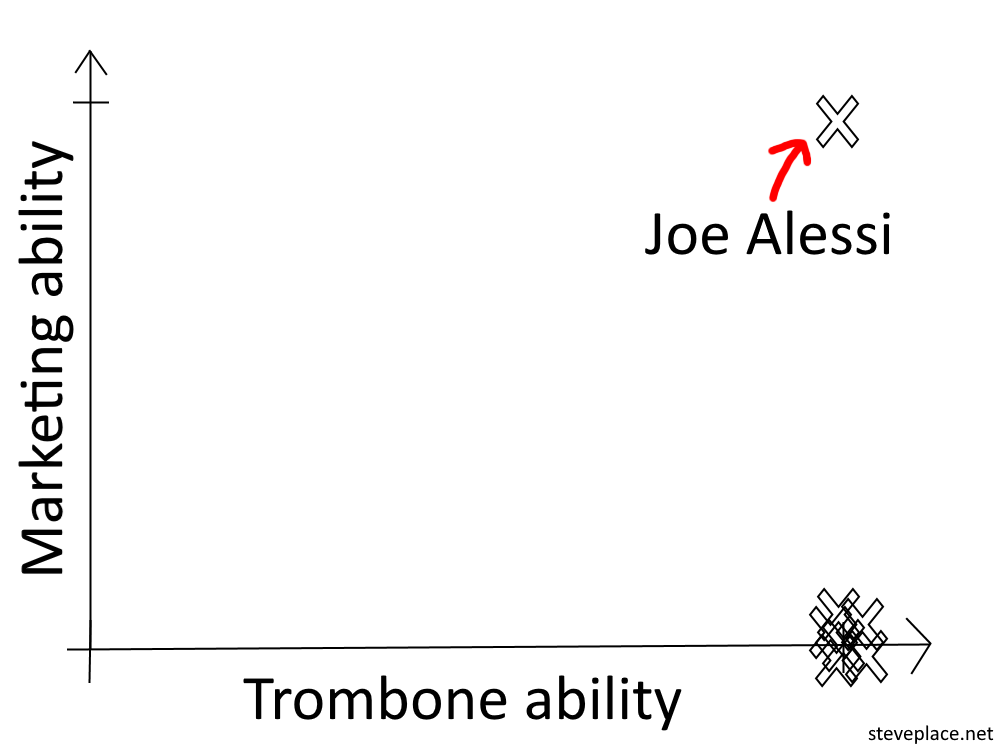
When you’re confronted with this set of trombone players, the choice for the number one spot is easy.

A purist might argue “Well who cares if he’s a likable self-promoter? His trombone ability should be the only thing that matters when judging who’s the best trombone player.” It should be the only thing that matters, but it isn’t. We’re lazy and use shortcuts to make decisions, even when those shortcuts have no bearing on “the thing” itself.

Another criticism is “He’s not that good at self-promotion. He wouldn’t last a day in a real marketing job.” Yes, but that’s not the game he needs to win. All he needs to do is be a bit better at marketing than the other top-tier trombone players to stand out.

“Sure, but that’s a low bar to get over. Most musicians know nothing about marketing!” Exactly. He knows the most in a field completely unrelated to his main one.

And when that field is selected intelligently, it makes all the difference.


[1] If you search “great trombone players“, you won’t find him 1st on every list, but he will show up on most/all lists. My “data” about public opinion of Joe is purely anecdotal, and my comment about non-professional trombone players means “high schoolers and college students who aren’t music majors”.
[2] Or at the very least, he’s the best marketer out of all the world-class trombone players.
Frontal Lobes

A friend once showed me a Tweet that said, “It would be nice if there was a ding that told you when your frontal lobes finished developing.”

My layman’s understanding of the frontal lobe is that its development increases your maturity. [1][2] I’ve heard various estimates of when your frontal lobes finish developing, ranging from 25 to 30.

Regardless, at 23, my frontal lobes are not finished developing.

I understand the appeal of wanting to know when your frontal lobes finish developing. I’ve done a lot of dumb shit in my life, as has anyone who’s ever been under 25. Remembering these moments makes me physically cringe (mercifully, the stupidity happens a lot less than it used to).

Putting aside the issue that I doubt there’s a clear point where your frontal lobes finish developing, I don’t think we should try to delay all our important life decisions till our late 20’s. [3]

Making important life decisions thoughtfully makes your more mature. When you try to handle an important decision thoughtfully and still manage to screw it up, the way you handle the fallout determines how much you’ll grow from the experience.

So if, like me, you have underdeveloped frontal lobes, don’t despair! We’ll keep making asses of ourselves for a few more years, but we can increase the quality of our decision-making by confronting our problems, rather than shirking them.

…But on the other hand – dumb shit can be pretty fun. We can grow up later.


[1] Per Wikipedia: “The function of the PFC [Prefrontal Cortex] involves the ability to project future consequences that result from current actions. PFC functions also include override and suppression of socially unacceptable responses as well as differentiation of tasks.” The Prefrontal Cortex is the largest part of the frontal lobe.

[2] To see the consequences of not having a frontal lobe, check out the story of Phineas Gage.

[3] I didn’t read the Tweet that inspired this post, so I could be misrepresenting the author’s arguments. If so, it’s unintentional. (Given that it was a Tweet though, I doubt much thought was put into it.)

Be Bored

When was the last time you did nothing for 30 minutes? Probably pre-2010, right?

This is killing us. Technology is only going to get more addictive as time moves on. Less addictive technologies, by definition, will be adopted to a lesser extent than the more addictive ones. And the more hits of dopamine an app can supply you (looking at you, TikTok), the shorter your attention span will become.

Good work requires long, uninterrupted periods of focus. We’ll never get important work done if we’re constantly interrupted. The work you can do while distracted is either already commodifiable or will be soon. The upside of this is that being able to focus in a distracted world is a superpower.

The author Neil Gaiman said, “To be creative, you first have to be very bored.” [1] I think about this a lot because it simultaneously excites and terrifies me. On the one hand, being creative is really simple. On the other hand, it’s really hard.

This isn’t a contradiction. Simple doesn’t mean easy.

I’ve started using the software Freedom to block websites and apps for a set amount of time. It’s really annoying, which means it’s doing its job.

Getting your attention back will hurt. A lot. But it will make you happier, less anxious, and more productive. Plus, you won’t be that dick who checks his phone when his super cool friend is trying to show him something (fuck you, Trevor). Where was I?

Anyway, take it slow. Anything is easy if you break it into small enough parts, so make the amount of time you block a website or put your phone in another room 1 minute at the start. Build up only when that amount of time feels easy. In the long run, you’ll make a ton of progress without ever having to exert yourself too much.

Lastly, to demonstrate my skin in the game on this issue: I wrote this and my article on changing your mind in one sitting. [2] Not bad, right?


[1] That’s a paraphrase, and he might be quoting someone else.

[2] Yeah yeah, I know I published them nearly 3 months apart. Thanks to my friends who asked me about the blog enough times that I finally got off my ass and uploaded this.

Change Your Mind

I dislike how polarized we’ve become.

We so often align ourselves with a group and adopt the beliefs of that group. You shouldn’t be able to guess a person’s stance on abortion based on their stance on wealth redistribution, but usually you can.

I wouldn’t mind so much if it didn’t involve the right and the left feuding like Biggie and Pac. There’s a lot of anger out there.

If our beliefs are tied up in our identities, then someone challenging one of our beliefs feels like they’re attacking us personally. And it’s damn hard to get along with someone who attacks you personally.

I have a few prescriptions for dealing with this.

First, keep your identity small. The more labels you give yourself (e.g. “Democrat”, “capitalist”, “contrarian”), the stupider you become. The label puts pressure on you to conform to it, so you become less willing to entertain opposing viewpoints, even ones you previously would have agreed with.

Second, use the steel man. A steel man is the opposite of a straw man. Rather than presenting the weakest version of someone’s argument, present the strongest. If you can still beat their argument after you’ve steel manned it, you can rest easy knowing your argument is better. If you can’t, consider changing your belief. [1]

Don’t say, “I could steel man their argument, so I don’t need to.” Do the steel man. Articulating their viewpoint affects your brain differently than simply knowing you could. It’s harder to get angry at someone when you’ve thought through their viewpoint. You can still get angry! Some people deserve it. But if you’re trying to mend a relationship, the steel man can give you the empathy to do so.

Lastly, when you’re in a heated argument (or thinking over a complex issue by yourself), ask yourself, “What would it take to change my mind?” Your instinct might be, “I can’t change my mind, that’s suicide!” That’s why I advocate for keeping your identity small. Take a deep breath, and lay out the terms, no matter how restrictive, under which you would change your mind.

Let’s do an absurd example. What would it take to change my mind that slavery was a good idea? I would support slavery if you could convince me that the people were better off as slaves, to the point where some people would volunteer for slavery, knowing all it entailed. I doubt you could convince me of that, but I’ve still entertained an argument I disagree with.

If someone says, “There’s nothing that would change my mind,” say, “Okay, then we won’t get anywhere. For both of our sakes, let’s talk about something else.”

These tools won’t ensure harmony in your relationships, but they’ll help. And when you’re trying to make things better, a step in the right direction can be self-perpetuating.


[1] Two reasons why people hold bad/incorrect beliefs:
-the belief helps you signal group membership (see “Crony Beliefs” by Kevin Simler for more on this)
-the situation you’re in is complex, and the belief explains everything neatly

If you can think of more reasons, let me know! There are plenty of others, but those are the two I see most often.

And remember, everyone holds bad beliefs for these reasons, even you and me 🙂

Never Again

Usually, when we say we’ll never do something again, we mean it. Unfortunately, we rarely follow through. Why?

When you make a statement like, “Baby, I feel terrible for cheating on you with the mailman, I’ll never do it again,” you’re saying it because you’re overcome with emotion.

But… that feeling fades more quickly than you expect it to. And the temptation comes back more quickly than you expect it to as well. Look, it’s not your fault the mailman’s ass looks great in those shorts!

When you say, “I’ll never do that again; this time it’s different,” you’re overestimating how long your negative emotions will make the bad behavior seem unappealing. Even if you feel guilty about something for years, that doesn’t mean you’ll never be tempted again.

So what to do?

Brief events can cause lasting change, but “feeling really bad” is usually not one of those events. See if you can remove any triggers of bad behavior in your environment (e.g. get the alcohol out of your house if you’re an alcoholic, avoid people who bring out the worst in you, etc.).

Plan how you’re going to respond when you inevitably face temptation (it’s hard to remove triggers completely). Do you have enough willpower in the first 10 seconds of temptation to walk away? Can you get your friends to hold you back (literally or figuratively) when they see you pining?

Taking these steps isn’t easy, but they’re more likely to help you stop than a dramatic proclamation in the 15 minutes after you sober up.

Oh yeah, and stay away from the mailman.

No One is Coming to Save You

At the company I work for, I have to attend a lot of meetings for younger colleagues. They all follow roughly the same cycle: The meeting organizer doesn’t prepare > They ask if anyone has questions > No one does because the meeting has a vague/nonexistent agenda > Awkward silence.

Apparently, no one’s gotten the memo that this is a bad way to run a meeting. Or perhaps this is the memo, because this happens often.

The problem is the people organizing these meetings are expecting someone to save them. They think someone will spark an engaging discussion, and all they (the organizer) had to do was gather the people together. Everyone else is expecting the meeting organizer to bring that spark, though, and we’re left with a room of sad people staring at each other.

Many people operate, either explicitly or implicitly, with a similar assumption in dating. We think that someone cool and sexy and fun will suddenly appear and take an interest in us, and all we had to do was “be ourselves”. This is a fine strategy if you’re Matthew Kidman or Anastasia Steele, but it rarely works in real life. The way to date an amazing person is to first be an amazing person yourself. (Check out this video for more on this topic.)

No one is coming to save you. If you want to have an interesting meeting, come prepared to lead a discussion, and expect you might have to fill in some awkward silences. If you want to find an amazing partner, be an amazing person that many people want to date. If you want to work with incredible people, create something that shows them you’re worth working with.

That’s what I’m trying to do with this blog. Let me know how I’m doing.

The Last Time

In Sam Harris’s fantastic Waking Up app, he has a lesson on the last time we do things. With anything you do, there’s a possibility it could be the last time you do it. This is important to think about often, because it makes experiences more special.

Even annoying experiences can be reframed in this light. I hated marching in parades when I was in high school, and I was dying for it to be the last time I did one of those. That wish misses the point of this exercise, though. There were positive parts to those parades, such as spending time with my friends and doing something positive for the community, to appreciate. Even if there hadn’t been, there’s value in reflecting on the ephemeral nature of experiences.

The most important of these reflections is Memento Mori, the reminder you will one day die. You can read more about it at the above link, or here for a similar idea from Tim Urban. The gist: contemplating death helps you clarify what is and isn’t important, and helps you appreciate life more.

This is all well and good, but we can make this kind of reflection stickier by adding more of them. You can reflect on the fact that:
-Other people you know, including your loved ones, will one day die
-Your romantic relationship will one day end (either by breakup/divorce, or one of your deaths)
-You won’t always be doing the work you’re doing (be that a job or an entrepreneurial project)
-Your children will grow out of many of their behaviors, and one day will leave the house
-Your friends could betray you, or abandon you, or just start being dicks
-The people you’re with, even in a healthy and long-lasting relationship, will change

These reflections might be depressing at first, but the only rational response is to focus on what you can control. They can energize you if you let them.


Thanks for reading! I’ll see you soon (unless, of course, this is the last time you’re on my site – I’ll miss you).

Make Things Sticky

If you want people to remember something, you’ll need to make it sticky.

No, Snoop, not that kind of sticky

If you see a cow today, you’ll likely forget about it tomorrow, and you almost certainly won’t talk to anyone about it. If you see a purple cow though, you’ll likely be talking about it for weeks. Purple cows are sticky.

Donald Trump did this in the 2016 election race when he branded his opponents, with the best example being “Lyin’ Ted”. This name was memorable for a few reasons (see the footnotes for the others), but the most interesting one was Trump’s use of “Lyin’”. Was it “Lying”, or “Lyin”? Wait, if it’s “Lyin’”, does it have an apostrophe? How are other people writing it?

This internal debate people had trying to parse “Lyin’ Ted” made the name stickier.

An important caveat: Making things absurd works only to a point. Had Trump called him “Flzftzldh Ted”, everyone would’ve forgotten about it. Things need to make sense to be remembered.

Tyler, the Creator is apparently aware of this principle. The first time I heard his song EARFQUAKE, I thought, “Shouldn’t it be spelled ‘ERFQUAKE’? No wait, that doesn’t make sense, because the original word is spelled ‘earthquake’ – the ‘A’ is supposed to be there. Still, it looks like ‘EERF-QUAKE’ the way he spelled it.” The “F” and capitalization don’t add anything semantically, but Tyler added them to make the title stickier (otherwise, he would’ve just called the song “Earthquake”).


Footnotes:
The other reasons “Lyin’ Ted” was memorable were: 1) branding someone in the way Trump did was uncommon in politics at the time, and 2) if you don’t know him or don’t like him, Ted Cruz looks like the kind of guy who could be a liar.

For a further discussion of influence strategies like “make things sticky”, check out Scott Adams’s fantastic book Win Bigly. I highly recommend it, regardless of where you are on the political spectrum.

Coronavirus and Incentives

It’s in your short-term interest to keep living your life as normal, because buying a ton of food at once and isolating yourself sucks. But it’s in your long-term interest (and the world’s short-term and long-term interest) to practice social distancing. We can beat this thing if everyone acts “irrationally” and holes up for a couple weeks. 

If we don’t beat this, hospitals will fill up, and people who need easily-fixable, but serious if left untreated, medical help could be in trouble.
Example: If you get shot in the leg, an ER doctor can fix you easily. But if all medical professionals are overworked because we didn’t contain the coronavirus, you’re in for a rough time.

This is similar to the issue of climate change – it’s in every country’s short-term interest to not enact environmental protection measures (because it slows the economy, among other potential negative consequences). However, it’s in every country’s long-term interest and the world’s short-term and long-term interest for every country to enact environmental protection measures. George RR Martin was trying to make this point with the White Walkers in Game of Thrones (see link below for an explanation).

Links:
Nassim Taleb (this tweet is the inspiration for this post)
vlogbrothers video on Game of Thrones and climate change

This Time It’s Different

“This time it’s different” are the most expensive words in investing, according to John Templeton. He’s talking about investors who panic to buy or sell thinking that a new fad is their route to guaranteed, quick wealth, or that an economic correction is a sign of the end times. I agree that it’s generally not a good idea to trade on impulse, but I want to talk about a broader application of the phrase.

The times I find myself saying “This time it’s different” are when I’ve disgusted myself by overindulging in a vice. Once the binge is complete, I solemnly swear that I will never go within 100 feet of my new sworn enemy, the vice I was so desperate to indulge in hours before.

…But then I think about the other times I’ve sworn off that particular vice. I felt certain I was going to quit then, so what makes this time different? The fact that I feel really motivated to quit right now?

After repeating this cycle enough times, I came to realize that I wasn’t always going to have the resolve my hungover self had. The pain of the hangover gave me strength in avoiding the vice, but it was unlikely I’d never feel weakness again.

The first time this thought occurred to me, my stomach sank. Am I doomed to a life marred by compulsion?

Fortunately, I think the answer is no. “This time it’s different” can be powerful words, but they have to be followed by a reason that this time will be different. A damn good reason.

“My attempt to quit smoking will be different this time because I’m going to pick up a copy of Allen Carr’s Easy Way to Stop Smoking,” is a much better reason than “I’m actually going to stop smoking this time because I just chained-smoked two packs, and the thought of smoking another cigarette makes me sick.”

(The Easy Way method is fantastic, by the way, and I recommend it for anyone who wants a new way to think about overcoming addiction.)

You don’t have to figure out the perfect reason on the first try – as if one exists. Even if you succumb again, you will at least have told the truth when you said, “This time it’s different.”

(P.S. If you’re wondering what particular vice prompted this essay, it was Pac-Man.)