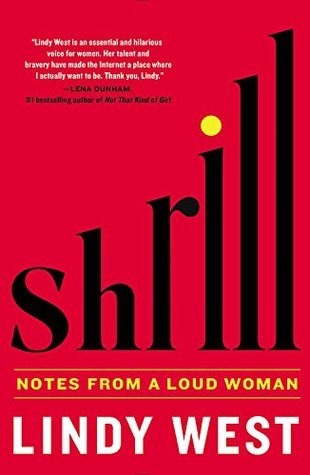
Shrill: Notes from a Loud Woman by Lindy West
Rating: 8/10
Amazon link (note: This is an affiliate link)
Overview: The first half of this book is angry but makes some good points. The back half is beautifully written, makes some excellent points, and is less angry. I was expecting to hate this, but ended up loving it.
West makes her arguments through a series of essays. The major points she argues are:
- It’s hard being fat, especially a fat woman, because of the way society stigmatizes fat people.
- It’s frustrating dealing with the stigma associated with periods.
- There should be less stigma around abortion (she’s trying to overcome a lot of stigma in this book). I never knew how abortion procedures worked prior to reading this. Very illuminating, and dark.
- Internet trolls are terrible, and you never quite get used to them.
- Comedy is amazing. Most of the time.
- There are right and wrong ways to make rape jokes, and the wrong way to do it is to make the victim the butt of the joke.
- Relationships are hard, especially when you’ve been hurt before.
- Dealing with the death of a loved one is hard, even when you can prepare yourself mentally for it.
Many of these points, especially the ones about stigma, were couched in a lot of anger. I understand why West is angry about these issues, but I think she hurt her persuasive appeal by being so angry. I emailed her about this, and I’ll update this page if she gets back to me.
To be clear, I don’t agree with West on everything she wrote in this book, but there were so many beautiful passages that I came away loving it. Here are some of my favorites. Bolded sections are chapter titles.
Are You There, Maragaret? It’s Me, a Person who is Not a Complete Freak
Sadly, there are no magic bullets. Real change is slow, hard, and imperceptible. It resists deconstruction. Likewise, lives don’t actually have coherent, linear story arcs.
Every human being is a wet, gassy katamari of triumphs, traumas, scars, coping mechanisms, parental baggage, weird stuff you saw on the Internet too young, pressure from your grandma to take over the bodega when what you really want to do is dance, and all the other fertilizer that makes a smear of DNA grow into a fully formed toxic avenger. Everyone is different, and advice is a game of chance. Why would what changed me change you? How do I know how I changed anyway? And how do you know when you’re finished, when you’re finally you? How do you clock that moment? Is a pupa a caterpillar or a butterfly?
A music festival is a kind of collective hangover in which people who are cooler than you compete to win a special kind of lanyard so they can get into a special tent with unlimited free Gardetto’s. The only food available to the non-lanyarded hoi polloi is expensive garbage dispensed resentfully from a shack.
You’re So Brave for Wearing Clothes and Not Hating Yourself!
Fat people are not here as a foil to boost your own self-esteem. Fat people are not your inspiration porn. Fat people can be competent, beautiful, talented, and proud without your approval.
Lots of men wanted to have sex with me—I dated casually, I got texts in the night—they just didn’t want to go to a restaurant with me, or bring me to their office party, or open Christmas presents with me. It would have been relatively simple to swallow the idea that I was objectively sexually undesirable, but the truth was more painful: There was something about me that was symbolically shameful . It’s not that men didn’t like me; it’s that they hated themselves for doing so. But why?
The Red Tent
I thought I was immune to its woo-woo power, but if it hadn’t been for menses tent, how long would it have taken me to understand that I get to choose what kind of person to be? Open or closed? Generous or cruel? Spirit jaguar or clinging ghost? A lazy writer (it’s easy to hate things) or a versatile one? I don’t believe in an afterlife. We live and then we stop living. We exist and then we stop existing. That means I only get one chance to do a good job. I want to do a good job.
Hello, I Am Fat
This is the great curse of popularity and the great luxury of obscurity: People only care about your mistakes when they can hear you. Only failures can afford to be cavalier and careless.
Why Fat Lady So Mean to Baby Men?
I sometimes think of people’s personalities as the negative space around their insecurities. Afraid of intimacy? Cultivate aloofness. Feel invisible? Laugh loud and often. Drink too much? Play the gregarious basket case. Hate your body? Slash and burn others so you can climb up the pile. We construct elaborate palaces to hide our vulnerabilities, often growing into caricatures of what we fear. The goal is to move through the world without anyone knowing quite where to dig a thumb. It’s a survival instinct. When people know how to hurt you, they know how to control you.
Strong People Fighting Against the Elements
My dad had four wives; my mom was the last. I think about how much faith it must have taken to keep going—to insist, over and over again, “No! I really think it’s going to work this time!” Plenty of people are irretrievably jaded after one divorce, let alone three. My dad went for it four times, and the last one stuck. You could frame that as womanizing or a fear of being alone, but to me it was a distillation of his unsinkable optimism. He always saw the best in everyone—I imagine, likewise, he stood at the beginning of every romance and saw it unspooling in front of him like a grand adventure, all fun and no pain. “Oh boy!” I can hear him saying each time. “Isn’t she just terrific?” The idea that a relationship is a “failure” simply because it ends is a pessimist’s construct anyway. Dad loved lots of people, and then found the one he loved the best.
Death Wish
I’ve always been told that “punching up” was a concept coined by Chris Rock. That attribution might be apocryphal—I can’t find a direct quote from Rock himself—but my enduring comedy hero Stewart Lee said it with some authority in a New Statesman column about why right-wingers make terrible comedians: “The African-American stand-up Chris Rock maintained that stand-up comedy should always be punching upwards. It’s a heroic little struggle. You can’t be a right-wing clown without some character caveat, some vulnerability, some obvious flaw. You’re on the right. You’ve already won. You have no tragedy. You’re punching down… Who could be on a stage, crowing about their victory and ridiculing those less fortunate than them without any sense of irony, shame or self-knowledge? That’s not a stand-up comedian. That’s just a cunt.”
It’s About Free Speech, It’s Not About Hating Women
My detractors paint me as some out-of-touch idealist, but Jim’s the one assuming that all comics approach their art with good intentions—that they’re all just trying to make people laugh. That’s simply untrue. It’s also deeply naive. There’s not a single comic working today who’s not doing it to fill a personal void; that’s why it means so much to them. The idea of someone else laughing is not remotely a good enough payoff to devote your life to something so difficult.
A suffocating deluge of violent misogyny was how American comedy fans reacted to a woman suggesting that comedy might have a misogyny problem. They’d attempted to demonstrate that comedy, in general, doesn’t have issues with women by threatening to rape and kill me, telling me I’m just bitter because I’m too fat to get raped, and suggesting that the debate would have been better if it were just Jim raping me.
The End
Cancer doesn’t hand you an itinerary. It’s not like, up to a certain point, you have an okay amount of cancer, and then one day the doctor’s like, “Uh-oh! Too much cancer!” and then all your loved ones rush to your bedside for some stoic, wise good-byes. Cancer, at least in my dad’s case, is a complex breaking down of multiple systems, both slow and sudden. You have six months and then you have six hours. Treatments are messy, painful, and often humiliating. The cost/benefit is anything but clear.
Grudgingly, I’d come to see Aham’s point a little bit. He fell in love with this person, and in my desperation to hang on to him, I morphed myself into something else entirely. He wanted a partner but I gave him a parasitic twin. Except worse than that. A parasitic twin that cried all the time. Worst X-Files episode ever.
The Beginning
It’s not that I’m not attracted to fat men—I’ve dated men of all sizes—but the assumption that fat people should only be with fat people is dehumanizing. It assumes that we are nothing but bodies. Well, sorry. I am a human and I would like to be with the human I like the best. He happens to not be fat, but if he were, I would love him just the same. Isn’t that the whole point? To be more than just bodies? When I think back on my teenage self, what I really needed to hear wasn’t that someone might love me one day if I lost enough weight to qualify as human—it was that I was worthy of love now, just as I was. Being fat and happy and in love is still a radical act. That’s why a wedding mattered to me. Not because of a dress or a diamond or a cake or a blender. (Okay, maybe a cake.)
Slaying the Troll
There’s no “winning” when it comes to dealing with Internet trolls. Conventional wisdom says, “Don’t engage. It’s what they want.” Is it? Are you sure our silence isn’t what they want? Are you sure they care what we do at all? From where I’m sitting, if I respond, I’m a sucker for taking the bait. If I don’t respond, I’m a punching bag. I’m the idiot daughter of an embarrassed dead guy. On the record. Forever.
So I talked back. I talked back because my mental health—not some troll’s personal satisfaction—is my priority. I talked back because it emboldens other women to talk back online and in real life, and I talked back because women have told me that my responses give them a script for dealing with monsters in their own lives. Most importantly, I talked back because Internet trolls are not, in fact, monsters. They are human beings who’ve lost their way, and they just want other people to flounder too—and I don’t believe that their attempts to dehumanize me can be counteracted by dehumanizing them.
If what he said is true, that he just needed to find some meaning in his life, then what a heartbreaking diagnosis for all of the people who are still at it. I can’t give purpose and fulfillment to millions of anonymous strangers, but I can remember not to lose sight of their humanity the way that they lost sight of mine.
Footnotes
“Whale” is the weakest insult ever, by the way. Oh, I have a giant brain and rule the sea with my majesty? What have you accomplished lately, Steve? [Well damn, screw you, Lindy.]
 Steve's Blog